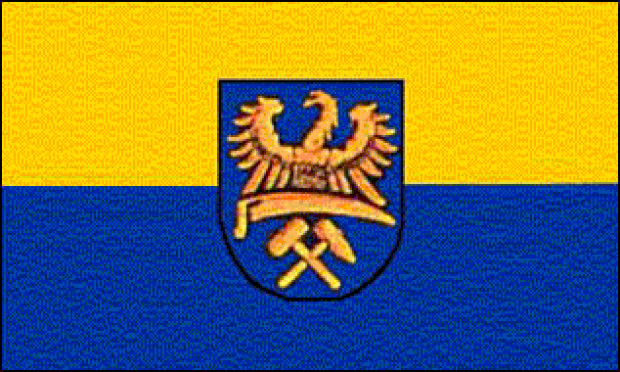
Flag of Upper Silesia (Prussian Province)


Background knowledge
Upper Silesia was detached from the Province of Silesia in 1919 and made a Prussian province of its own with Oppeln as its capital. Barely created, it was fought over: the plebiscite of 1921 and three Polish uprisings ended with the eastern industrial area passing to Poland in 1922, while the west remained with Germany, including the towns of Oppeln, Beuthen, Gleiwitz and Hindenburg. Even this remnant ranked among Europe's largest industrial districts, with hard coal, zinc and steel, while the north around Kreuzburg stayed agricultural. The population was bilingual, German and Polish, and it was precisely this that fuelled the quarrel over the border. In 1938 the province was reunited with Lower Silesia and separated again in 1941. After 1945 the whole of Upper Silesia went to Poland.
Meaning
The flag shows two horizontal bands of equal width, yellow above and blue below, and at the centre the provincial shield: a golden eagle on a blue field, beneath it the mallet and chisel, the mark of mining. The two bands come from these same arms — gold became yellow, and the blue of the shield became the lower band. The colours set Upper Silesia clearly apart from Lower Silesia, which carried white and yellow, although both had come out of the same province. The usual distinction was that the plain version of two bands served as the civil flag, while the one shown here, with the arms, was the service flag of the authorities.
Upper Silesian flag color codes
- HEX
- #FFCC00
- RGB
- (255,204,0)
- CMYK
- (0,20,100,0)
- HEX
- #003399
- RGB
- (0,51,153)
- CMYK
- (100,67,0,40)
Discover something new
Random flags from our large flag database.