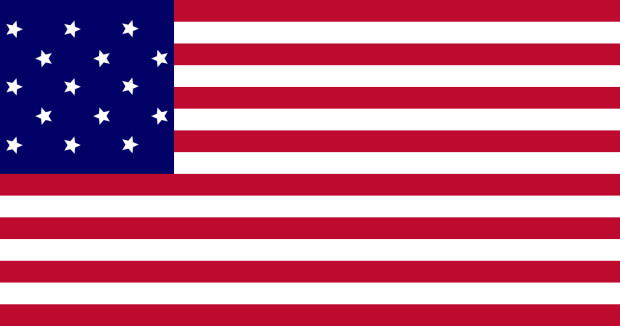
Flag of Star-Spangled Banner (USA 1795-1818)

Background knowledge
When Vermont joined the Union in 1791 and Kentucky in 1792, Congress decided in 1794 to raise both stars and stripes to fifteen. This flag was in force from 1795 to 1818 and is thus the only one ever to carry more than thirteen stripes. It became famous in the War of 1812: in the night of 14 September 1814 British ships bombarded Fort McHenry off Baltimore. The lawyer Francis Scott Key watched the attack from a ship and at daybreak saw the flag still flying over the fort. He wrote a poem about it that became the national anthem of the United States in 1931. The original Fort McHenry flag hangs today in the Smithsonian in Washington.
Meaning
The flag shows fifteen horizontal stripes, eight red and seven white, and in the blue canton fifteen white stars in five rows. Stars and stripes counted alike at that time: for every new state both were to grow by one. The idea failed on arithmetic — with each accession the stripes would have grown narrower until the flag could no longer be made out at a distance. In 1818 Congress therefore returned to thirteen stripes for the founding colonies and let only the stars keep growing. This version is the only one whose number of stars does not follow today's rule.
American flag color codes
- HEX
- #FFFFFF
- RGB
- (255,255,255)
- CMYK
- (0,0,0,0)
- RAL
- 9010
- HEX
- #BF0A30
- RGB
- (191,10,48)
- CMYK
- (0,95,75,25)
- HEX
- #000067
- RGB
- (0,0,103)
- CMYK
- (100,100,0,60)
Discover something new
Random flags from our large flag database.