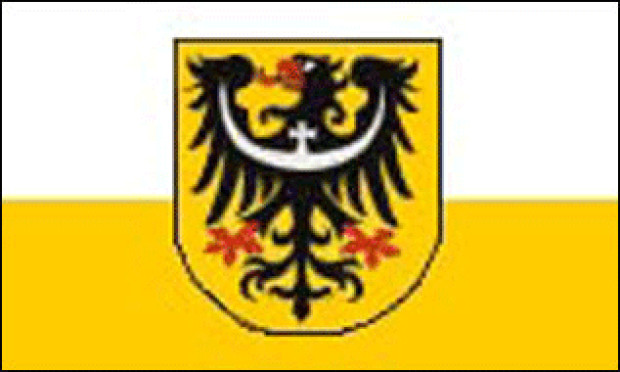
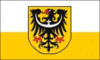
Flag of Lower Silesia (Prussian Province)

Background knowledge
Lower Silesia was a Prussian province of its own from 1919 to 1938 and again from 1941 to 1945. It came about when the large Province of Silesia was divided after the First World War: the industrial east was separated off as Upper Silesia, while the western and larger part remained as Lower Silesia, with Breslau as its capital and the districts of Breslau and Liegnitz. The country lived from farming on the Silesian plain, from weaving at the foot of the Giant and Owl Mountains, and from lignite around Görlitz; with more than 600,000 inhabitants, Breslau was one of the largest cities of the Reich. In 1938 the two halves were reunited as the Province of Silesia, and separated again in 1941. After 1945 Lower Silesia passed almost entirely to Poland; west of the Neisse only a narrow strip around Görlitz stayed with Germany.
Meaning
The flag shows two horizontal bands of equal width, white above and yellow below, and upon them at the centre the provincial shield: the black Silesian eagle with its silver crescent on a golden field. The two bands are derived from precisely those arms — silver became white, gold became yellow. They are the same colours the undivided Province of Silesia had carried, and Lower Silesia took them over as its larger successor. The usual distinction was that the plain version of two bands served as the civil flag, while the one shown here, with the arms, was the service flag of the authorities.
Lower Silesian flag color codes
- HEX
- #FFFFFF
- RGB
- (255,255,255)
- CMYK
- (0,0,0,0)
- RAL
- 9010
- HEX
- #FFCC00
- RGB
- (255,204,0)
- CMYK
- (0,20,100,0)
Discover something new
Random flags from our large flag database.