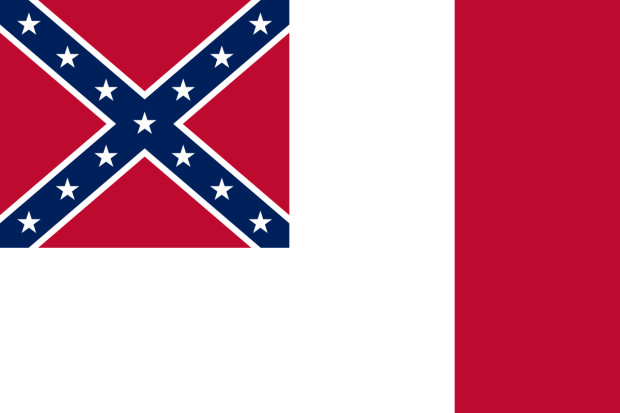
Flag of Blood-Stained Banner (Confederate States 1865)


Background knowledge
The Confederate States carried three national flags in the course of the war. The second, from 1863, was almost entirely white with the well-known cross in the canton. It had a practical drawback: hanging limp in calm weather, it showed nothing but white cloth — and on the battlefield white is the sign of surrender. On 4 March 1865 the congress in Richmond therefore resolved to add a vertical red bar at the fly end. Five weeks later Robert E. Lee surrendered at Appomattox. This flag was thus the shortest-lived of the three and was hardly ever manufactured.
Meaning
The flag shows a white field, in the canton the red saltire with white border and thirteen white stars, and at the fly end a vertical red bar. The thirteen stars stood for eleven states that had seceded plus Kentucky and Missouri, which the Confederacy claimed but never controlled. The red bar was not an emblem but a makeshift: it was to keep the flag from being mistaken for a white flag in a calm. The nickname Blood-Stained Banner arose only later. The cross in the canton is the same device usually meant today when people speak of the Confederate flag — yet it was never their national flag but a battle flag.
American flag color codes
- HEX
- #FFFFFF
- RGB
- (255,255,255)
- CMYK
- (0,0,0,0)
- RAL
- 9010
- HEX
- #BF0A30
- RGB
- (191,10,48)
- CMYK
- (0,95,75,25)
- HEX
- #00205B
- RGB
- (0,32,91)
- CMYK
- (100,65,0,64)
Discover something new
Random flags from our large flag database.