Flag of Yugoslavia



Background knowledge
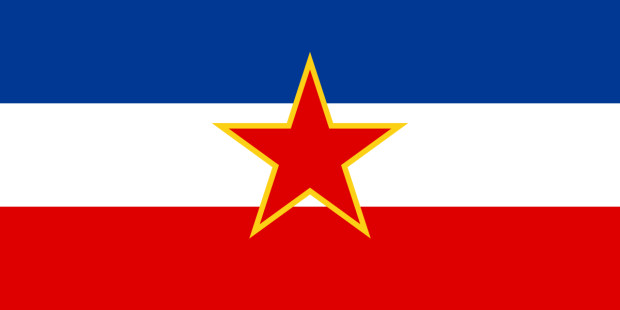
The flag of Yugoslavia shows three horizontal bands of blue, white and red with a large red star in the centre, edged in gold. The tricolour goes back to the Slavic Congress held in Prague in 1848 and stood for the unity of the South Slavs; the five-pointed star was added in 1945 by Tito's People's Liberation Movement. In this form the flag flew from 1946 to 1992 over the Socialist Federal Republic of Yugoslavia and its six constituent republics.
Meaning
Blue, white and red are the Pan-Slavic colours, chosen in Prague in 1848 as a sign of kinship among all Slavic peoples and modelled on the Russian flag. In Yugoslavia they stood for the union of Serbs, Croats, Slovenes, Macedonians, Montenegrins and Bosnians in a single state. The red star at the centre, rimmed in gold, was the emblem of the partisans and later of the Communist Party. It is deliberately large enough to reach beyond all three bands: the new order was meant to arch over every people alike. When the state broke apart in 1992, the star vanished from the flags of the successor republics.
Hymn
The anthem of Yugoslavia was “Hej, Slaveni”. The words were written in Prague in 1834 by the Slovak pastor and poet Samuel Tomášik – dismayed at hearing more German than Czech in the streets, he first wrote them as “Hej, Slováci”. The melody he took from the Polish “Mazurek Dąbrowskiego”. At the Slavic Congress of 1848 the song became the unofficial anthem of the Pan-Slavic movement. It was sung in Yugoslavia from 1945 and written into the constitution in 1988; Serbia and Montenegro kept it until 2006.
Yugoslav flag color codes
- HEX
- #003893
- RGB
- (0,56,147)
- CMYK
- (100,62,0,42)
- HEX
- #FFFFFF
- RGB
- (255,255,255)
- CMYK
- (0,0,0,0)
- RAL
- 9010
- HEX
- #DE0000
- RGB
- (222,0,0)
- CMYK
- (0,100,100,13)
- HEX
- #FCD115
- RGB
- (252,209,21)
- CMYK
- (0,17,92,1)
Discover something new
Random flags from our large flag database.