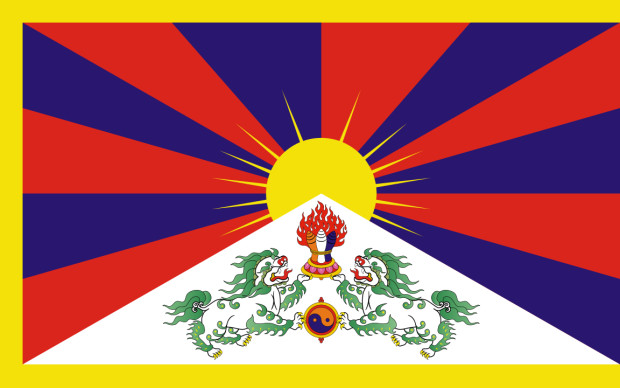
Flag of Tibet


Background knowledge
The flag of Tibet, also known as the Snow Lion Flag, shows a white snow mountain at its centre with a golden sun rising above the peak. Twelve rays run from the sun to the edges, alternating between six red and six dark blue. In front of the mountain, two white snow lions with turquoise manes face each other. Together they hold up a flaming three-coloured jewel, and between them lies a two-coloured swirling jewel. A golden-yellow border frames the flag on three sides: top, bottom and hoist. The fourth side is left open. The usual ratio is 5:8.
The Tibetan government in exile explains the symbols as follows: the snow mountain stands for Tibet, the land surrounded by snow mountains. The six red rays recall the six original tribes of the Tibetan people, while red and dark blue together refer to the country's two protector deities. The sun means freedom, happiness and prosperity for everyone in Tibet. The snow lions embody fearlessness and the unity of spiritual and secular life. The three-coloured jewel represents the Three Jewels of Buddhism – the Buddha, his teaching (Dharma) and the community (Sangha) – and the swirling jewel stands for self-discipline and right conduct. The golden-yellow border symbolises the spread of the Buddha's teaching, and the open side an openness to other ways of thinking.
According to Tibetan tradition, banners bearing snow lions were already carried by the armies of the Tibetan kings in the 7th century. The flag received its present form in 1916 under the 13th Dalai Lama, who merged the various military banners into a single flag. The Japanese monk Aoki Bunkyō, who was living in Lhasa at the time, is said to have contributed to the design. Until 1951 it was the flag of a de facto independent Tibet; in 1947 it was displayed at the Asian Relations Conference in New Delhi alongside the flags of other Asian countries. After Chinese troops entered Tibet in 1950–51 and after the uprising of March 1959, following which the 14th Dalai Lama fled to India, it was banned in the People's Republic of China.
Today it is the flag of the Tibetan government in exile in Dharamsala in northern India and, around the world, a sign of Tibetan identity and of the wish for self-determination. China regards it as a former military banner and a symbol of separatism; anyone displaying it in Tibet faces punishment. Every year on 10 March, the anniversary of the 1959 uprising, towns and cities in many countries raise the flag. In Germany, several hundred town halls have taken part each year since 1996 in the campaign "Flagge zeigen für Tibet" ("Show the flag for Tibet").
Discover something new
Random flags from our large flag database.