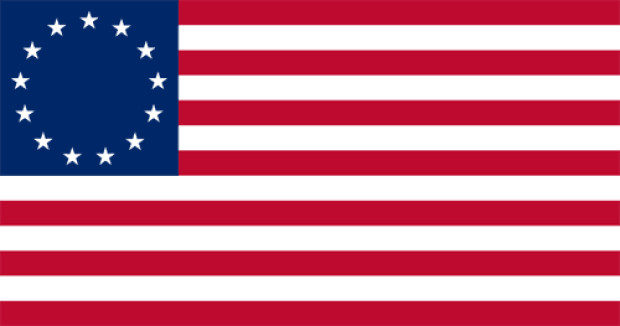
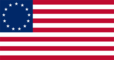
Flag of Betsy Ross (USA 1777-1795)


Background knowledge
On 14 June 1777 the Continental Congress passed the first flag resolution of the United States. It was two lines long and laid down thirteen stripes in red and white and thirteen white stars on a blue field — no more than that. How the stars were to be arranged was left open, and so rows, arcs and the circle we know today as the Betsy Ross flag arose side by side. Betsy Ross was an upholsterer and seamstress in Philadelphia. That she sewed this flag and proposed the five-pointed star was first told by her grandson in 1870 — there is no evidence from her own time. Today the congressman Francis Hopkinson, who asked to be paid for the design in 1780, is more often credited.
Meaning
The flag shows thirteen horizontal stripes in red and white and in the blue canton thirteen white stars arranged in a circle. The thirteen stands twice for the same thing: the thirteen colonies that joined into a union. The circle is the statement — it has no beginning and no end, no order of rank, no first and no last place. No state stands above another. The stripes the flag took from the sign of the Sons of Liberty; the blue canton took the place of the British Union Jack that the preceding flag had still carried.
American flag color codes
- HEX
- #FFFFFF
- RGB
- (255,255,255)
- CMYK
- (0,0,0,0)
- RAL
- 9010
- HEX
- #BF0A30
- RGB
- (191,10,48)
- CMYK
- (0,95,75,25)
- HEX
- #00205B
- RGB
- (0,32,91)
- CMYK
- (100,65,0,64)
Discover something new
Random flags from our large flag database.